
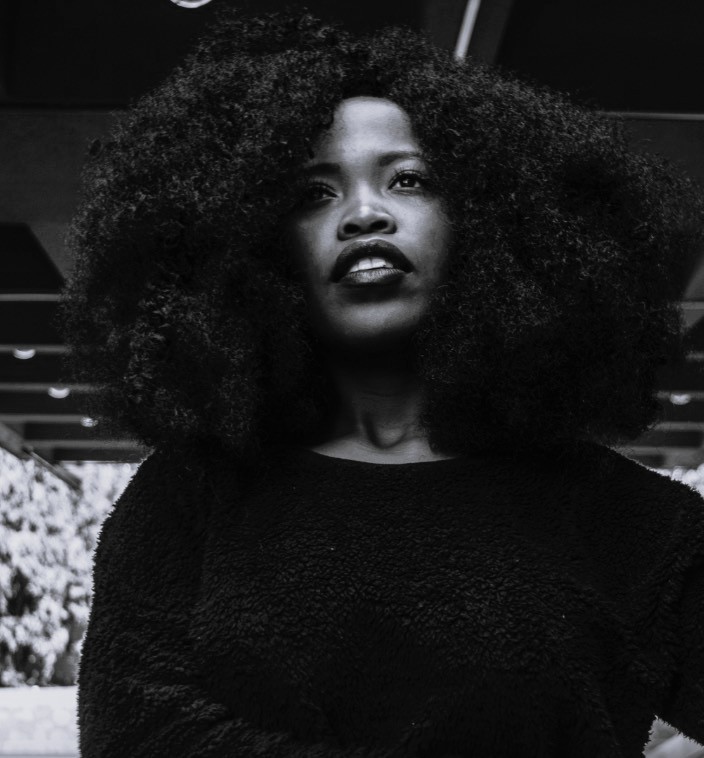
Gontse Riet
BIOGRAPHY
Gontse Riet is a journalist and interdisciplinary researcher interested in the intersections of human–computer interaction (HCI), cyborg anthropology, and African knowledge systems, philosophies, and creative practices.
As part of the first cohort in the Master of Philosophy in Health Humanities and the Arts, she authored the inaugural dissertation examined in the program, which was an interdisciplinary approach to healthcare. She considered Donna Haraway’s cyborg metaphor as a thought experiment into the multifaceted intersections of technology and embodiment, using contemporary ethnography to look at how smartwatches operate simultaneously as technologies of care, companions, convivial machines (Nyamnjoh, 2015), aesthetic objects, and data-driven surveillance interfaces. Its interdisciplinary nature and timing at a pandemic juncture enabled the exploration of the social determinants of health, medical pluralism, biocultural approaches, as well as an analysis of a critical health humanities in Africa through diverse perspectives and practices from cellular biology, fine art, public health, theatre, oncology, music, comedy, family medicine, and other fields, connecting to broader areas such as the environmental humanities.
Her Honours research at the University of Cape Town’s Centre for Film and Media Studies mapped the African creator economy through the lenses of critical algorithm studies, data feminism (D’Ignazio and Klein, 2020) and visual culture. She analysed how calibrated amateurism, economic precarity, and how platforms and intelligent systems influence cultural expression as they transform autonomy and productivity.
RESEARCH
The provisional title for her autoethnographic and integrated PhD is: ‘Textures of the Self: Making khoenkhoen bricoleurs and convivial assemblages’, and considers indigenous knowledge systems and self-determination as essential sources of knowledge for a sustainable human ecosystem. She develops an interdisciplinary bricolage to “reculturate” (Abrahams, 1994:30) and build innovative containers for memory, epistemic equality and convivial futures.